
Durians - Scourge or Specialty
It's durian season in Singapore and we've been wondering where the king of fruit got its mixed reputation from. In this newsletter, we take a deep dive into this creamy and pungent world.

Reputation Management
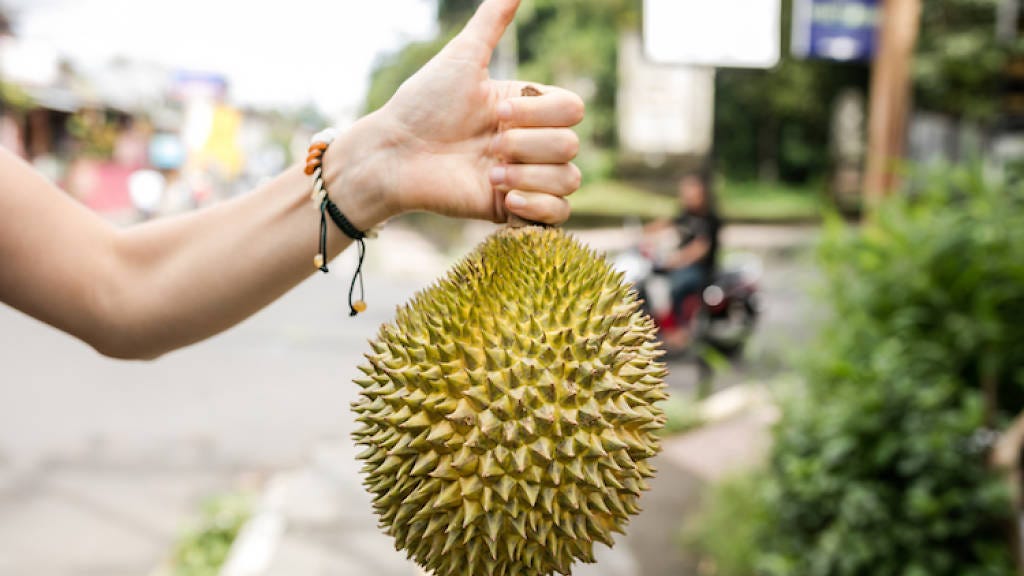
Just to get some historical context - the durian is thought to be first seen in the region of Borneo and Sumatra, with wild trees in the Malay peninsula, and orchards commonly cultivated in the region ranging from India to New Guinea.1 As of four hundred years ago, it was known to be traded across present-day Myanmar and was actively cultivated especially in Thailand and South Vietnam.
In the 15th century, the records of Niccolò de' Conti, who travelled to Southeast Asia, indicate2:
"They [people of Sumatra] have a green fruit which they call durian, as big as a watermelon. Inside there are five things like elongated oranges, and resembling thick butter, with a combination of flavours."
For those who are familiar with the fruits of the tropics, you wouldn’t be surprised to find out that during the early stages of its taxonomical study, there was some confusion between durian and the soursop (Annona muricata), for both of these species had thorny green fruit. The Malay name for the soursop is durian Belanda, meaning Dutch durian.
Surprisingly, the general attitude of visitors who were not from the Southeast Asian region towards the durian was one of fascination rather than disguest. One may ask then - how did durian start get to its notorious reputation, especially in Singapore? Some argue that it was the outsized influence of people like Singapore coloniser, Sir Stamford Raffles that contributed to the ostracization of the fruit.
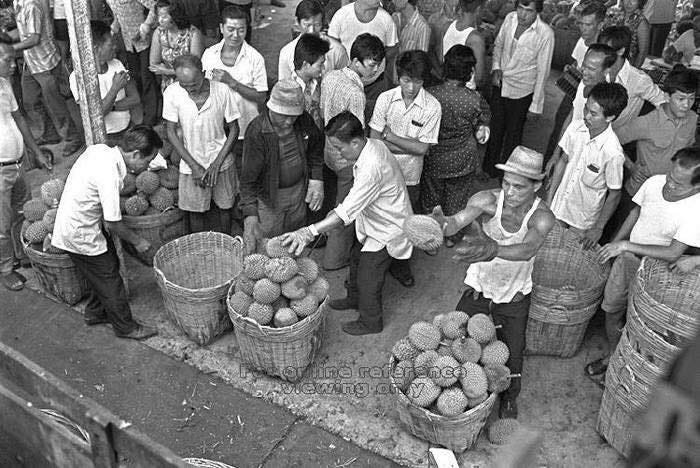
The story goes3 that during one of Sir Stamford Raffles’ three visits to Malacca – made between 1807 and 1810 – a Malay native turned up at his house to sell some durians. He was waiting at the entrance, but as soon as Raffles caught the smell of the fruit, he held his nose and ran upstairs, never allowing any durians in his home again. It was documented in a book written by Munshi Abdullah, scribe and interpreter for Raffles, that he said
“The smell of those durians has given me a headache. That food is nauseating.”
By this point, if you’re curious on why durians are so smelly, researchers at the Leibniz-Institute for Food Systems Biology at the Technical University of Munich (Leibniz-LSB@TUM) have thankfully found the answer4:
"Our findings suggest that as the fruit ripens, a plant-specific enzyme releases the odorant from ethionine [an amino acid]… This is consistent with our observation that during fruit ripening not only the ethionine concentration in the pulp increases, but also at the same time that of the ethanethiol. The latter explains why a ripe durian emits an extremely strong smell.”
In present day, we know that the durian is a widely polarizing fruit. You either love it, in which case you’ll be chasing down the best fruits of the harvest each season, or you hate it, likely explaining why you’re scratching your head trying to figure out why the fruit is so popular. Each way, you won’t be alone.
Check out the Podcast!
Have you heard Elliot and I go on a humorous adventure on the topic of durians yet? This is one of our more laughter-packed episodes as we reminesce on our favourite durian memories and explore the significance of this thorny fruit to the Singapore identity.
Varieties to Remember
If you want to wear your Singapore badge with pride, regardless of which camp you sit in, you’ll want to know your basic durian varieties. We’ve shortlisted three main ones to take note of.
D24
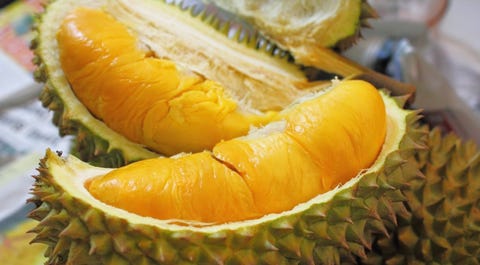
The D24 durian, also known as Sultan Durian, only appeared on the scene in the late 2000s5, and was the dominant fruit until the Mao Shan Wang varietal took over later. It’s good value for money given the high flesh-to-seed ratio. The flesh is golden yellowish in colour and has a creamy texture with a bittersweet taste.
Share the gift of knowledge
Elliot and I want to make SGExplained the go-to online explainer content channel for all things Singaporean. We need your help as an SGExplainer, a proud member of our community, to do that! Click on the share button below and you can let other people know about the interesting discoveries we’re making as we research our identity! Try sharing the newsletter with at least THREE people!
Mao Shan Wang (D197)
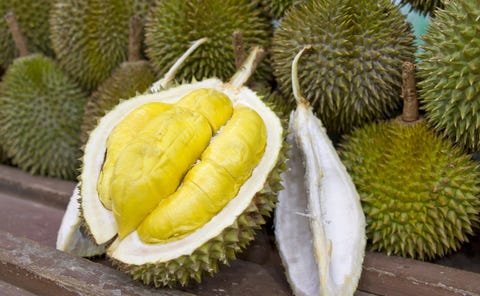
This durian variety has a number of aliases6 including Musang King, Cat Mountain King, Rajah Kunyit and Butter Durian. It’s the current heavyweight and its sticky-creamy flesh can be sweet, bitter or even bittersweet. The Musang King originated from a very old tree in Gua Musang, Kelantan but it wasn’t till the 80′s that a man named Tan Lai Fook (from Fook Gor Farm) stumbled upon the tree in Gua Musang and brought a branch back to Raub and started cultivating it. Today, Mao Shan Wang from Raub and neighbouring Bentong in Pahang are still regarded as the best in Malaysia.
Black Thorn (D200)
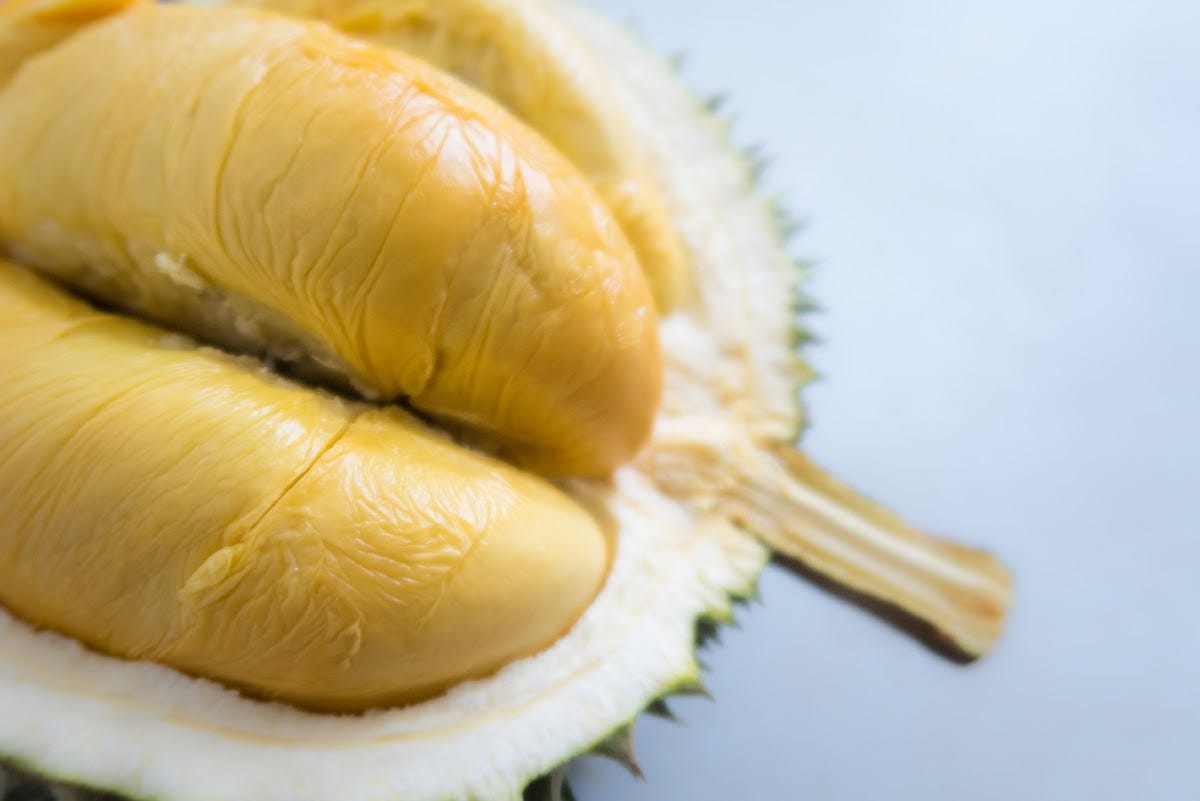
The supposed up and coming threat to the Musang King is the Black Thorn (codenames: Duri Hitam, Or Chee, Heici). This durian originated from Penang and won first prize in the Penang State Durian competition in 2011 and 2012. According to durian tour operator Lindsay Gasik, the Black Thorn mother tree is located in Kampung Lima Kongsi near Sungai Bakap on the mainland side of Penang.7 The pods are are a creamy, pinkish shade, and the taste is often on the sweeter side.
Bonus Variety: The Ubin Durian
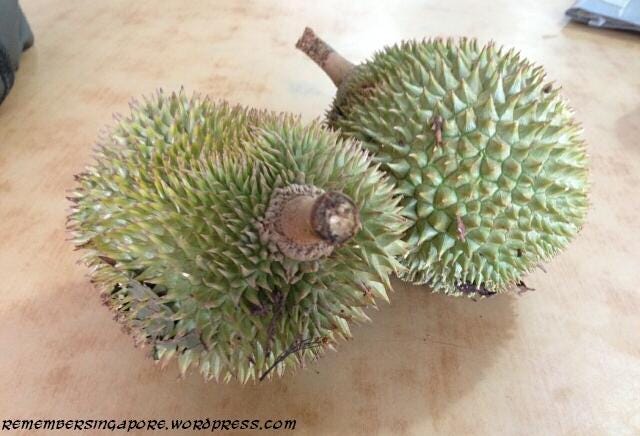
Okay, this may not be a hot variety, but you’ll boost your trivia knowledge by being able to spit facts about the Durio Singaporensis, or the Singapore Durian. We talked about it in the podcast, but you’ll be happy to know that there are some sellers who actually collect the Singaporean variety from old trees in Ubin (where there’s more open land), and sell them in carparks in Dempsey.8 Affectionately known as kampung durians, the flesh could be either bitter or sweet so you’ll have to take your chances!
Support the SGExplained Effort
We hope you’ve enjoyed this limited free edition of the newsletter. The rest of our newsletters will be accessible only to paying Substack subscribers. For the foreseeable future, we plan to keep our podcasts free to access but the Substack newsletter will be our way to reward our paying subscribers with bonus content. We value your financial contributions to help us cover the cost of production and re-invest into more extensive research and quality technical work.
Each podcast is jam-packed with research, interwoven with perspective and occasional guest insights, and the newsletter gives you bonus content including pictures, links, and other visual treats. We plan to release around one newsletter a week so your contribution will go a long way. You can develop a deeper bond with the Singapore identity (and gain some cool trivia facts) with each email!
For being an early reader (or a friend and family), we have a special promo for you! We hope you join us in our community!
What does this mean for the Singapore Identity?
Whenever my international friends visit, I always tell them that they have not fully experienced Singapore till they’ve tasted durian. It doesn’t even have to entail eating the flesh off the seed - a durian puff gives you enough of an understanding of the creamy and slightly pungent fruit.
This love-hate relationship that we have with the thorned king creates a common point of reference wherever and whenever we meet another Singapore resident. The lack of universal affection creates diversity that has low-stakes for conflict. You’re more likely to laugh at your difference in proclivity to the fruit rather than go to war over it.
Of course, the indigenous nature of the Durio Singaporensis is also worth remembering. We have biodiversity that’s worth protecting and celebrating! Even if it doesn’t meet the standards of the heavyweight varieties, it’s our variety and we can be proud of it!
Sources:
Morton, JF (1987). "Durian". Fruits of Warm Climates. Florida Flair Books; republished in New Crop Resource Online Program, Center for New Crops and Plant Products, Department of Horticulture and Landscape Architecture, Purdue University. ISBN978-0-9610184-1-2.
Brown, Michael J. (1997). Durio – A Bibliographic Review (PDF). International Plant Genetic Resources Institute (IPGRI). p. 3. ISBN978-92-9043-318-7.
Did you know that Raffles hated durians? - Makansutra.com
The Ultimate Singapore Durian Guide - ieatishootipost
Types of Durians: Malaysia - Durians.com
Where Do Black Thorn Durians Come From? - AirAsia.com
Wan Li Xiang 万里香: In pursuit of the Singapore Durian - ieatishootipost